
39 Things I Know
Welcome to my mind!


I have too many ideas. Please take some.
This (stolen) format struck me as an ideal way to introduce the blog and my perspective. If you like what you see, subscribe for more.
I know what I believe. The meaning of life is feeling, and the purpose of life is heroism.
I know that simplifications can express essential truths, and right now, authoritarians are on the offensive and democracies are defending themselves. Each such conflict can result in either 1) the democrats winning, such that nothing changes, or 2) the authoritarians winning, such that the world becomes more authoritarian. The only possible direction of change in this situation is toward authoritarianism. The world will become more and more authoritarian until we democrats begin actively destroying and replacing authoritarianism.
I know how the Conservative Party of Canada could have won the 2025 federal election: by starting an all-out culture war over cars. By framing car dependency as core to Canadian identity, prosperity, and sovereignty, and by promising action to deepen it. This would have: 1) won support from many people worried about the tariff-threatened Ontarian auto sector; 2) let the Conservatives posture as bigger anti-Trumpist patriots than the Liberals; 3) implied pro-transit progressives to be national traitors; 4) maneuvered dissenting right-wing culture warriors like Danielle Smith and Preston Manning into agreement with CPC rhetoric; 5) shored up support from wealthy and/or rural Canadians who don’t want their taxes to fund public transit; and 6) forced the suburban populist Doug Ford to stop fraternizing with Liberals and take the CPC’s side. All this while increasing fossil fuel consumption, thus enriching the fossil fuel industry which supports them and Trumpism alike.1
I love dying of heart disease. I know how tarot can be genuinely useful: as a psychological mirror. Each card asks you: “What patterns related to this random abstract concept can you observe or predict in your life?”. This question can efficiently flush out and link your conscious and subconscious expectations, knowledge, and feelings.2
I know that the first human to carve a symbol into a rock created an artificial superintelligence3, in a sense. A rock can remember anything carved into it for millions of years. A human can only remember anything for as long as a human lives, at best.
I know that vegetables - especially leafy greens - last a lot longer if you place paper towels with them to absorb moisture. Rotate out the wet paper towels for dried ones daily.
I know that Club House brand pumpkin pie spice mix can elevate jams and pies to divinity. More broadly, we don’t add spices to desserts, and especially fruity desserts, nearly enough. It’s a terribly sad set of missed opportunities. Spice your sweets.
Similarly, I know that Western society is missing out on entire universes of culinary delight by treating wheat as the default base of baked goods - so much so that in English, the word “flour” is assumed to mean wheat flour. What are we doing? Rye, sorghum, corn, barley, rice, and numerous other grains are right there to be experimented with and blended. Wheat can be delicious, but the mind reels at the possibilities we’re neglecting through our refusal to experiment with cookies, cakes, and pie crusts built on other grain bases - never mind the entirely new dishes we’d invent if we thought seriously about this. Someone get on this, please; I’m busy making horrible dubstep screech noises.
On that note, I know that the early-2010s dubstep boom ended because no progressive visionaries emerged to revitalize the genre with new intellectual motivation in the way that the prog-rockers rescued rock and roll from irrelevance in the ‘70s. An art movement can persist indefinitely in stasis by establishing a fringe cultural ecosystem (see: present-day punk rock), but mainstream ascendancy hinges on an art movement’s will to advance a frontier. Taylor Swift could only have become Taylor Swift by creating something so spectacularly audacious as the Eras Tour.
I know that I don’t love writing the same way I love making electronic music. Writing engrosses me, but my music - my artform, through which I grasp and channel the meaning of the universe as I feel and understand it - restores me to clarity and elevates me to a higher moral station. If you’ve found a spiritual calling like this, you need to organize your life around it.
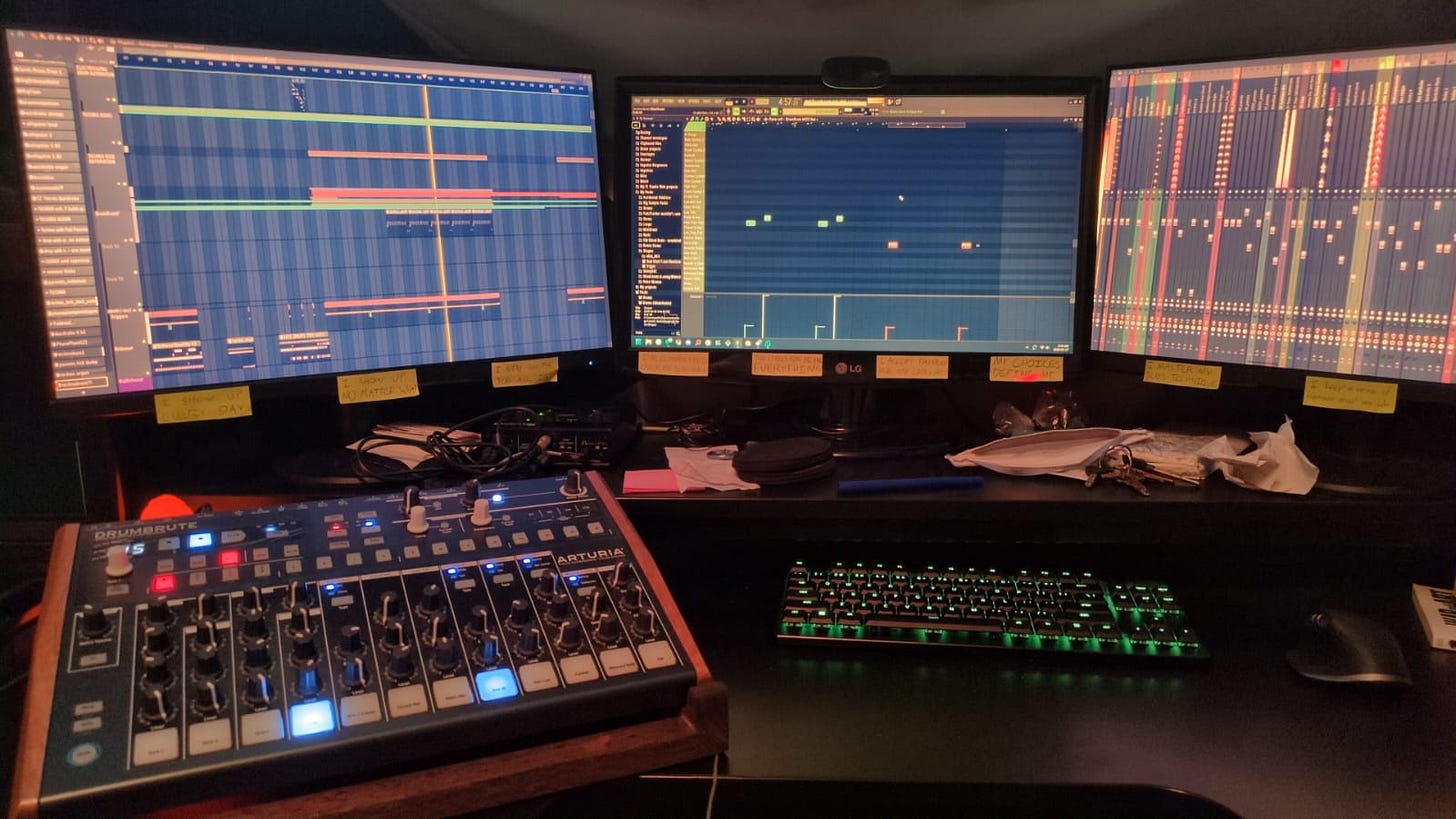
If it can reliably summon a flow state at 2:00 AM, it’s a vital health practice. I know that my jobs in this life are three: in no particular order, politics, music, and friendship. All else is either nutrition or distraction. What are your jobs?
I know that friendship is a giving act, and so you must empower your friends to help you with your struggles. This can be hard to remember if your friend is chronically ill or otherwise caught in miserable circumstances. You might feel an instinct to conceal your pain from them, since they are already coping with so much, but doing so will starve your bond. And that bond, if strong, can fortify their health. Whatever your friend may be going through, you can offer them strength to face it with by providing them with opportunities to nurture their love for you.
I know one way to ruin a mind: give them your whole heart, help them profoundly, and then, while continuing to actively care for them, abuse them so terribly that they leave you. A person who learns to interpret genuine, effective care as a manipulative prelude to abuse will soon turn against anyone else in their life who loves them competently. A person who learns to interpret their own feelings of safety and trust as signs of danger will lose their ability to maintain bonds that already exist, never mind forming new ones.4
I know one way to estrange a loved one: let them win. Fold when you disagree. Concede everything you should along with everything you shouldn’t. Deface, obscure, and sabotage the evidence that you are the person they love.
I know that being true to yourself, accepting in all ways the mission of becoming the best possible version of what you really are, is all there is.
I know that in a crisis, moderation is insanity. I, for one, am glad that my country didn’t practice moderation when it mobilized to defeat the Nazis.5
I know that reality is always in crisis. The emergency doesn’t end when wartime becomes peacetime. There’s always someone starving. We could save them. We could mobilize.
I know that if there isn’t someone starving, there’s something to build. There’s something great we’ll miss if we don’t seize our chance.
I know that amoral self-interest can never produce a good outcome that could not be equaled or surpassed by other means. Moral reasoning and love both can include oneself as an equal among others.
I know that the process that most efficiently obtains resources and uses them to reproduce itself is the one that will dominate its environment over time. Obviously this is the principle behind evolution, but it’s also the principle behind... the fate of everything in the universe that life will ever touch. Try applying it to movement-building. If you don’t engineer a mechanistic process that proliferates your worldview more efficiently than others, your worldview will be outcompeted for resources and replaced by those other worldviews.6 So we’d best figure out how to mechanistically proliferate civil rights. We’d best figure out how to press the advantages of Liberty.7
I know that ideals are theoretical. Humans aren’t made of philosophical concepts - we’re self-aware pinball machines. We and our emotions are made of subatomic particles pinging off each other - or perhaps they’re made of us, if consciousness gives rise to matter rather than the other way around.
I know that even if one attains permanent nondual mindfulness, and even if one is rationally aware that reality is a chemical accident, it’s possible to remain locked into idealized, irrational views about how humans work.
I know that it’s commonplace to hold beliefs too deeply and too emotionally to realize that they’re irrational or that they’re filtering your perception of reality. This can prevent you from recognizing information that would contradict such beliefs.
I know the horror of unmooredness, the grief for one’s old and dying self, that overcomes a person when new information collapses a belief that had granted them false moral clarity.
I know that the above is a marker of deep self-improvement. You’re growing. Soon you’ll be healthier than ever.
I know that everyone is an idiot sometimes. Whoever you are, you’re wrong about some things, and you don’t know what they are. If you knew, you wouldn’t be wrong about them anymore. This isn’t a flaw so much as it is a product of your humanity. I can’t embody perfect logic either.
I know that our species hosts a horrifying variety of opinions on simple questions with obvious answers.
I know that the classic meme applies. I have chosen to fight:
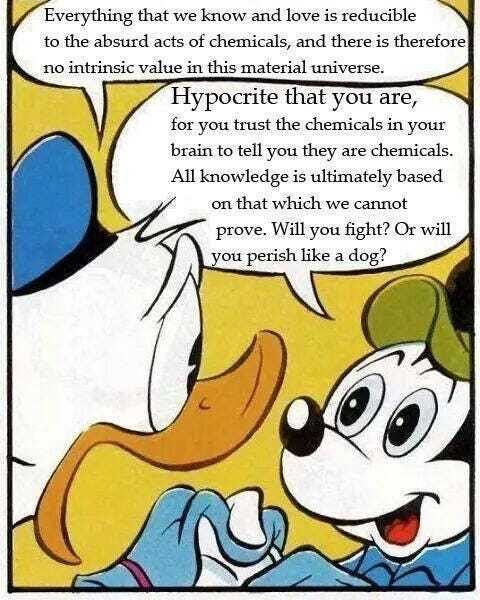
This image is the original source of these words. Do you remember when you loved the Internet? I know my oddball psychological profile. I’m hyperthymic, demisexual8, lightly autistic9, strongly tendersexual, and Jeskai to the core10.
I know that teenagers would be far better off for life if we walked them through a comprehensive list of archetypical psychological traits, both common and uncommon, so that they could learn to work kindly with their and others’ personal flavours of weirdness. It’s difficult to overstate how much better my life could have gone if someone had explained to my fifteen-year-old self what makes me different from others.
I know that if you’re a boy in high school, asking out your crush is the opposite of a distraction. You don’t want to graduate completely clueless about romance. Better to start making and learning from mistakes now - the partnership you’ll grow to yearn for will require competence and self-knowledge, both of which require experience.
I know that Canadian and American cities are so uniquely terrible because they were designed for segregation. All a classic North American suburb is is a place where everything except the most expensive form of housing - single-family detached homes - is banned. It was invented in 1916 by White residents of Berkeley, California, who realized that if they banned more affordable housing, then only White people would be able to afford to live there. I think it is bad, actually, to deliberately make housing as expensive as possible for the purpose of segregation.11 Legalize apartments.
I know that an increase in the supply of market-rate housing will reduce the cost of housing and reduce homelessness. Housing isn’t some unique exception to the basic laws of economics such as supply and demand. However, you can easily get the impression that it is an exception if you don’t understand the difference between manufactured goods like housing and the naturally-occurring, finite, and increasingly-valuable land which the housing occupies.
 Jeremiah Johnson 🌐@JeremiahDJohnsEvery piece of info we have suggests that building housing reduces rents quick thread:
 1:45 AM · Feb 24, 2024 · 246K Views11 Replies · 300 Reposts · 1.27K Likes
I know one dead giveaway that a person is in denial: avoidance of data.
Caveats, qualifications, semantics, yada yada, but I know that Henry George was right.
I know that global politics is radically precompetitive. Georgism is best viewed as a set of fundamental principles similar in simplicity and importance to Newton’s laws of motion. It would empower any government to rapidly outgrow, outcompete, and overpower its rivals through an explosive combination of poverty eradication, ecological restoration, and tax abolition. It’s right there waiting to be picked up, but the vocabulary of status-quo politics blinds world leaders to Georgism’s existence.
I know that the doomers aren’t counting on second-wave Georgism either.


38.
I know that freedom and equality are one and the same. Together, I like to call them Liberty.
Without freedom - i.e. under authoritarianism - the authorities who curtail others’ freedoms are not equal to the people they rule over. That’s how, far from creating a classless utopia, Soviet communism created the Holodomor, in which the Soviet ruling class condemned millions of Ukrainians to the maximally-oppressed underclass of the dead.
Without equality, the wealthy can use their wealth to control politics and curtail others’ rights for their personal gain - sometimes by funding political proxies, and often by manufacturing mass cultural delusions through pet media outlets and “think tanks”. (Climate denial is an obvious example of a manufactured delusion.) This is how billionaires and corporations in democratic societies gradually install their self-serving ideas in power and gradually become an unelected ruling class.
This happens because power is power whether it takes the form of political control or the form of wealth. Political control and wealth can 1) be traded for each other, and 2) be leveraged to obtain even more political control and wealth. Thus, either political or financial inequality tends to collapse into Tyranny, the opposite of Liberty, in which a tiny ruling class hoards both forms of power.
If we make the bold assumption that Tyranny is bad, then with this dynamic in mind, politics becomes the wicked problem of engineering our way out of this trap and motoring as far away from it as possible. Politics becomes the task of delivering ever greater freedom and equality for everyone. Politics becomes the praxis of Liberty.
If Tyranny were inevitable, democracy and civil rights would never have flourished anywhere. I know that we can make things better.
Let me know if you’d like me to expand any of these ideas into full posts! And especially let me know which ideas you most dislike, because those ones would probably benefit most from fuller explanation.
